
Bettendorf Previous Residents Across Eras
No source spans the full history of a Bettendorf house. Modern parcel and deed systems are strongest for title. Library and archive series extend the trail into older lots, directories, taxes, census years, maps, and newspapers. The ranges below are documented collection spans, not promises that every address appears in every year.
| Source | Years documented | Where held | What it shows |
|---|---|---|---|
| AVA scanning project | About March 1971 forward was the project target | Scott County Recorder | Indexed parties, deeds, dates, references, legal descriptions |
| Scott County deeds | 1838–1910 | State Historical Society | Early land and title chain |
| Deed and mortgage index | 1838–1891 | State Historical Society | Grantor and grantee route into books |
| Davenport directories | 1855 to present; address section from 1890–91 | Richardson-Sloane | Names, addresses, heads, businesses, work clues |
| Iowa state census | 1856, 1885, 1895, 1905, 1915, 1925 | Archives and research databases | Household and place evidence |
| Sanborn maps | 1886, 1892, 1910, about 1948, 1956 | Richardson-Sloane and map access | Building footprint, use, materials, lot setting |
The federal census adds Iowa schedules through 1950 under the 72-year rule, but the 1890 schedules are lost. Directories and Iowa state censuses can help bridge that missing decade.
Start Bettendorf House History at Parcel
Search the present address in the Scott County Parcel and Map Service. Copy the current owner, parcel number, situs, mailing address, legal description, map link, and the date of the card. The situs is the physical site. The mailing address is where the tax notice goes, and it does not prove where the owner lives.
A parcel number links the map and tax card, while the complete legal description links the property to Recorder instruments. Save both. A later split, consolidation, condominium unit, or new subdivision can make one old address correspond to several modern parcels.
Ownership and residence must remain separate. A company, estate, or trust may hold title. Renters and other occupants may never appear on a parcel card. Those people require directory, census, newspaper, probate, or other dated evidence.
Carry Bettendorf Deeds Backward
The Scott County deed chain begins with the legal description, not merely the street number. In AVA, a grantee is a buyer or recipient and a grantor is a seller or giver. Confirm each result against the same lot, block, subdivision, or section description.
- Search the current owner as grantee. Narrow by date and instrument type when those controls are available.
- Open the matching index entry and record the grantor, grantee, recording date, document or book-page, and legal description.
- Search the seller as an earlier grantee. Match the property again before adding the transfer.
- Repeat the seller-as-grantee step until the public index stops or the parcel description changes.
- For a split or consolidation, inspect plats, surveys, corner certificates, easements, and the parent legal description.
- Move to Recorder counter books, library film, or state archives when the online chain ends.
The Scott County online land-record FAQ explains that AVA is free, uses the same information as office computers, and releases entries only after recording, indexing, and verification.
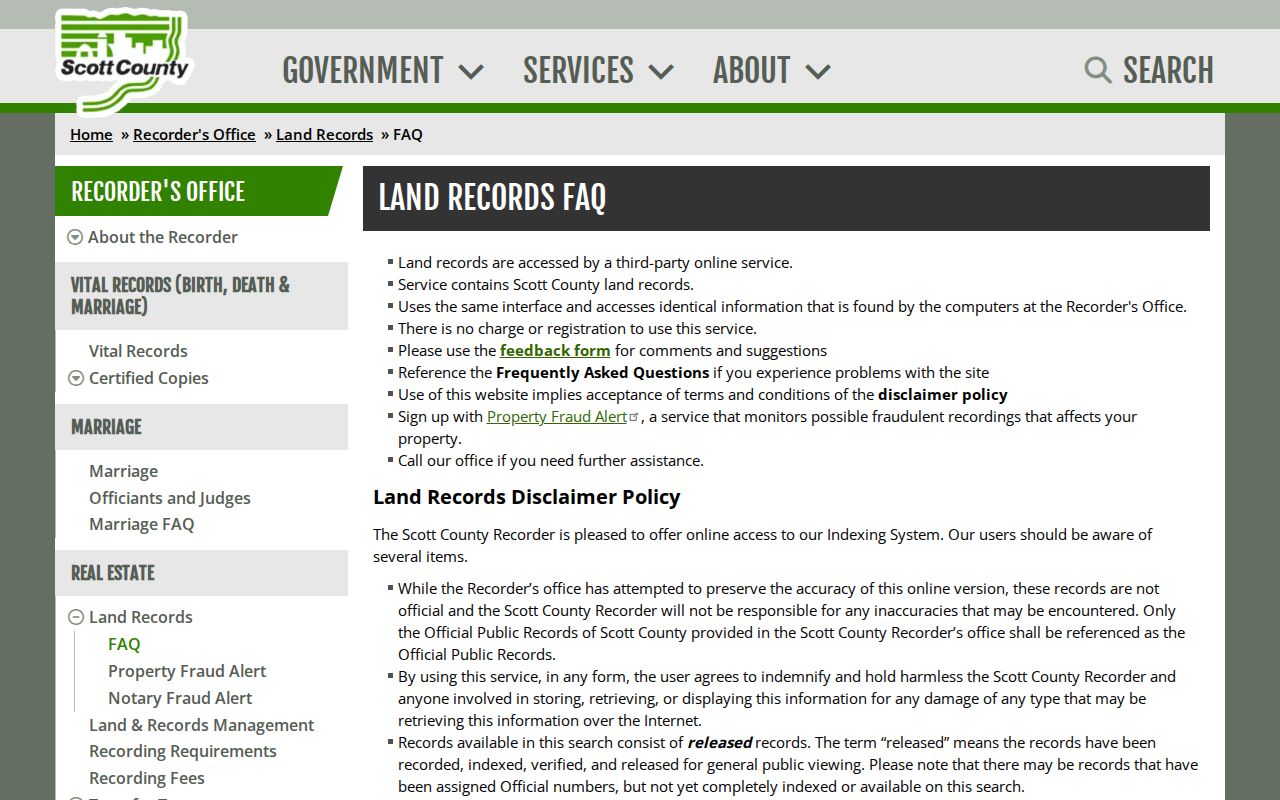
The web index is not the official record, so request a copy from the Recorder when proof of a transfer is needed.
Bettendorf Deed Terms in Plain Words
A previous residents timeline is clearer when party roles and land keys are written out once.
- Grantor
- The seller or person transferring an interest in the property.
- Grantee
- The buyer or person receiving that interest.
- Chain of title
- The linked sequence of transfers for the same land.
- Legal description
- The recorded lot, block, addition, or section description that identifies land apart from its mailing address.
Document numbers and book-page references tell where an instrument sits in the official record. An index entry points to the document; it is not the same as a certified copy.
Bettendorf Title Records Beyond Deeds
The Recorder holds more than purchase deeds. Mortgages, easements, covenants, contracts, foreclosures, releases, liens, plats, surveys, leases, and related instruments can explain a gap or change in a property's history. A plat may show how an old tract became a new subdivision. A release can close an earlier lien without changing ownership.
The Recorder's land-record management inventory sets out those official record groups.
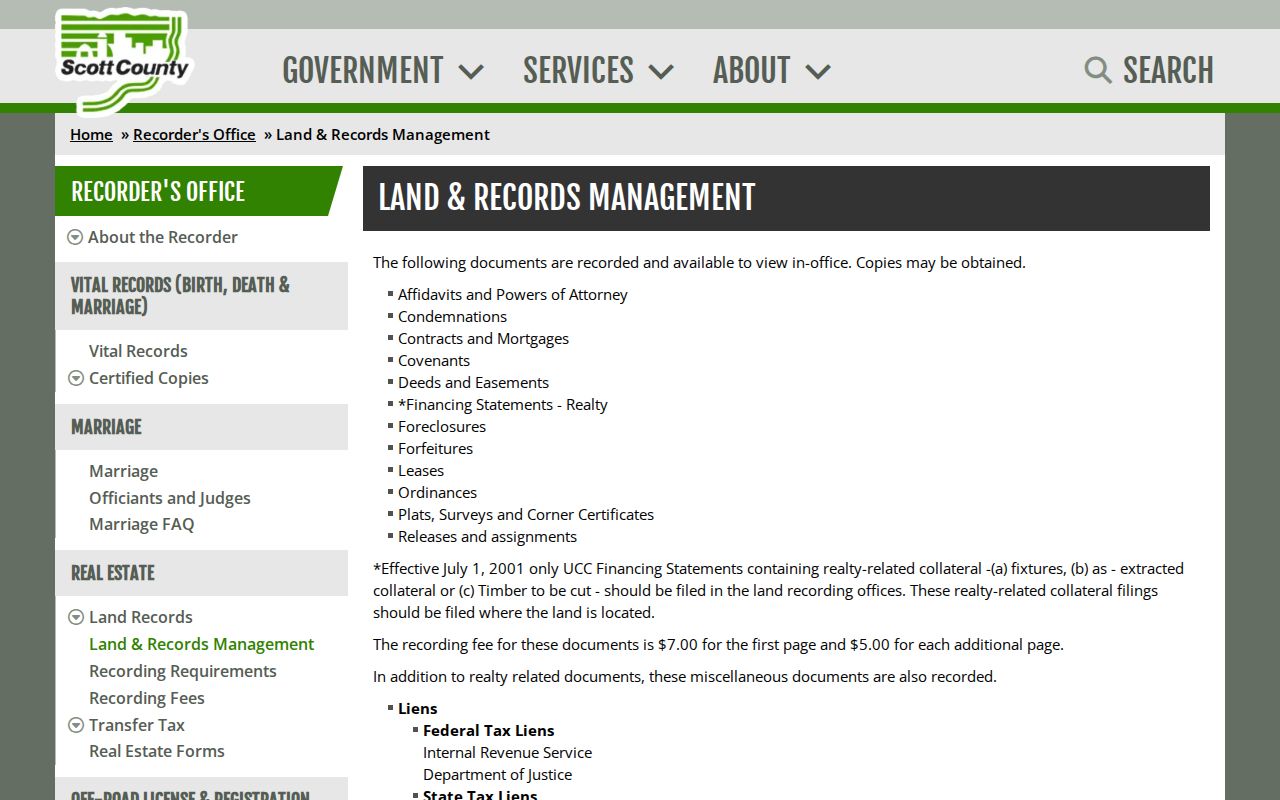
Use the inventory to ask for the right series when an AVA party search alone does not resolve the parcel.
Common deed-copy research can also be done in person at the Scott County Recorder, 600 W. 4th Street in Davenport, Monday through Friday, 8 a.m. to 4:30 p.m., with document processing through 4 p.m. The office phone is 563-326-8621.
Where Bettendorf Online Deeds Stop
Recorder scanning papers from 2019 describe phases for roughly March 1971 through December 1988 and a goal of bringing March 1971 to the present online. The current AVA landing screen does not name its oldest complete live year. Treat the project dates as provenance, not proof that every deed and image is online.
The State Historical Society's Scott County inventory reaches much farther back.
Its Recorder series includes deeds from 1838–1910, town lots from 1855–1903, and a deed and mortgage index from 1838–1891.
The statewide county records catalog explains series-level and microfilm access through a research center.
Richardson-Sloane offers a closer local bridge with Scott County deed, town-lot, grantor-grantee, Auditor transfer, tax, permit, and map material.
Bettendorf Previous Residents in Two Lists
Owners are only one part of a house history. Richardson-Sloane's Davenport directory run starts in 1855, and some volumes explicitly include Bettendorf. From 1890–91, an address section lists heads of household and businesses by street. It may also provide work, spouse, or widow notation in the alphabetical entry.
A census answers a different question. From 1850, federal schedules generally list household members, while directories tend to focus on a head or working adult. Iowa's state censuses can fill dates between federal counts, and the 1925 schedule is especially useful for Iowa research. Neither source should be treated as flawless or current beyond its stated year.
- Find the address in the nearest available directory year and copy the entry exactly.
- Search the closest released census by name, place, and age, then inspect the household and neighboring entries.
- Compare street, occupation, spouse, age, and linked relatives rather than trusting the surname alone.
- Move to the next directory year to bracket arrival and departure, then confirm the change with another source.
The collections themselves, including catalog and reading details, are covered in the Bettendorf city directory.
Map Bettendorf Buildings Before Names
Sanborn fire-insurance maps can show a building's footprint, construction material, number of stories, use, and nearby structures. Richardson-Sloane documents sets from 1886, 1892, 1910, about 1948, and 1956. Exact Bettendorf sheet coverage must be checked before claiming that a house appears.
A map cannot name each past resident. It can show whether a structure existed in a given map year and whether the lot's use changed. Pair the sheet with a directory entry, tax transfer, deed, or permit record from the same period.
No official Bettendorf-wide street renumbering date was found. When an old number fails, compare maps, directory spellings, plats, legal descriptions, and city records. Keep the old and modern address forms side by side rather than silently replacing one.
Note: A missing Sanborn sheet means only that the available map set did not cover the site or year, not that no building stood there.
Bettendorf House Clues Beyond Title
The Davenport Library house-research method pairs directories and Sanborn maps with tax records, deeds, building permits, census, newspapers, and local files. Davenport permits are documented on microfilm for about 1923–1970, while the guide references a broader 1920–83 span. Bettendorf coverage must be confirmed before using those runs.
For current city data, Bettendorf One Stop searches permits, licenses, planning projects, and code cases by street-only address. It can reveal work and application dates, not who occupied the property. Older newspapers may report a sale, visit, death, anniversary, fire, business, or move. Search title-specific runs and read the original item because the local collection has gaps.
Obituary and probate evidence can close a previous residents trail. An obituary may identify relatives and a residence, while probate can identify heirs or a successor. Match dates and relationships back to the address and deed chain instead of merging people who share a name.
Bettendorf Records Outlived a Courthouse
Scott County organized in 1838. Its second courthouse, built in 1886, suffered cracks, settling, and termite problems before demolition in 1955. The current building is the third courthouse on the site. That change does not prove that old records vanished.
The lesson is practical: a current counter or portal is only one access layer. Series inventories, library holdings, and microfilm preserve material created under earlier buildings and systems. Ask for the record group and date span, not simply “everything for this address.”
Iowa's missing 1890 federal census creates a real gap, but it does not end the search. An 1890–91 street directory, an 1895 Iowa census, tax material, deeds, newspapers, church files, or probate can supply separate points on the timeline.
Watch New Bettendorf Property Filings
House history normally looks backward, but a new filing can affect the chain after the research date. Scott County offers Property Fraud Alert, which sends notice when a recorded document matches an enrolled name. It does not prevent recording, certify fraud, or replace review of the document.
The Scott County Property Fraud Alert enrollment is the official notification route linked from Recorder materials.
A December 2025 county committee packet reported 3,831 total subscribers and 667 new subscriptions during that quarter. Those figures are a dated snapshot, not a constant enrollment total.
Limits on Bettendorf Previous Residents
Directories may list only a head or business. Census records can contain errors. Deeds show parties to title, not every occupant. Parcel cards emphasize present administration. Newspapers report selected events. A sound history marks each name as owner, deed party, directory entry, census member, heir, or other supported role.
Use an evidence ledger with date, name spelling, role, source, document reference, legal description, image status, and confidence. This prevents a same-name match from becoming a false household claim and makes later checks easy.
Lawful use. Research previous residents for house history, family history, estates, and personal curiosity. Do not use names or addresses to stalk, harass, track, or harm a living person.
Note: Safe at Home and other confidentiality rules can create lawful gaps in recent address and voter evidence.